
Understanding how to calculate final grade is one of the most important academic skills for students, teachers, and parents. Whether you’re in high school, college, or preparing for competitive exams, knowing your final grade helps you track performance, set goals, and avoid last-minute surprises.
you’ll learn a simple, accurate, and step-by-step method to calculate final grades easily, along with formulas, examples, and expert tips based on standard academic grading systems.
What Is a Final Grade?
A final grade is the overall score you receive in a subject after combining all assessments such as:
- Assignments
- Quizzes
- Midterm exams
- Final exams
- Projects or presentations
Each component usually carries a specific weightage (%), which contributes to your final result.
For example:
- Assignments: 20%
- Midterm: 30%
- Final exam: 50%
Your final grade is calculated using these weighted values.
Why Calculating Final Grade Matters
From an academic performance perspective, understanding your grade calculation helps you:
- Identify weak areas early
- Improve study planning
- Predict final exam outcomes
- Reduce academic stress
- Set realistic GPA goals
Educators and academic institutions worldwide use weighted grading systems because they provide a more accurate reflection of student performance over time.
Final Grade Formula (Simple Explanation)
The most common formula used is:
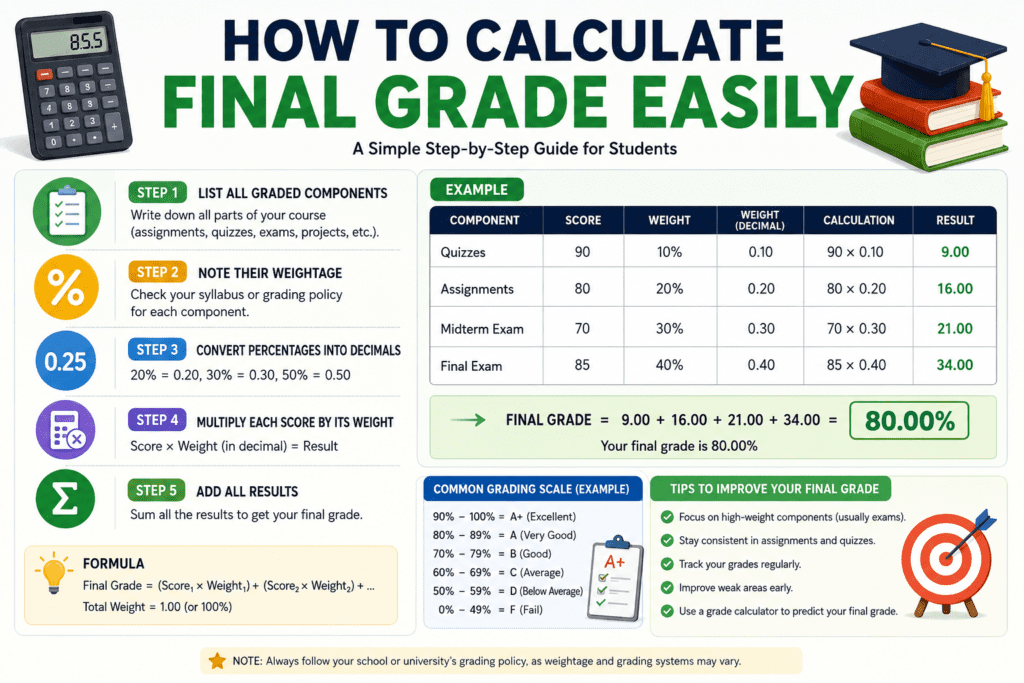
Final Grade = (Score₁ × Weight₁) + (Score₂ × Weight₂) + …
Example Formula:
If your grades are:
- Assignments: 80 (20%)
- Midterm: 70 (30%)
- Final Exam: 90 (50%)
Then:
Final Grade = (80 × 0.20) + (70 × 0.30) + (90 × 0.50)
Step-by-Step: How to Calculate Final Grade Easily
Let’s break it down into simple steps.
Step 1: List All Graded Components
Write down all parts of your course:
- Homework
- Quizzes
- Exams
- Projects
Step 2: Note Their Weightage
Check your syllabus or grading policy.
Example:
- Homework = 20%
- Midterm = 30%
- Final Exam = 50%
Step 3: Convert Percentages into Decimals
- 20% → 0.20
- 30% → 0.30
- 50% → 0.50
Step 4: Multiply Each Score by Its Weight
Example:
- Homework: 85 × 0.20 = 17
- Midterm: 75 × 0.30 = 22.5
- Final Exam: 88 × 0.50 = 44
Step 5: Add All Results
Final Grade = 17 + 22.5 + 44 = 83.5
👉 Your final grade is 83.5%
Real-Life Example (College Scenario)
Let’s say a student has the following scores:
| Component | Score | Weight |
|---|---|---|
| Quiz | 90 | 10% |
| Assignment | 80 | 20% |
| Midterm | 70 | 30% |
| Final Exam | 85 | 40% |
Now calculate:
- Quiz: 90 × 0.10 = 9
- Assignment: 80 × 0.20 = 16
- Midterm: 70 × 0.30 = 21
- Final Exam: 85 × 0.40 = 34
Final Grade = 9 + 16 + 21 + 34 = 80%
Common Grading Systems Explained
Understanding grading systems helps you interpret your final grade better.
1. Percentage System
Used in most schools:
- 90–100% = A+
- 80–89% = A
- 70–79% = B
- 60–69% = C
2. GPA System
Used in universities:
- 4.0 = A
- 3.0 = B
- 2.0 = C
3. Letter Grade System
Common in US and international schools:
- A, B, C, D, F
How to Calculate Final Grade Without a Calculator
If you don’t have a calculator:
- Convert percentages into fractions
- Multiply step-by-step
- Round numbers for easier calculation
- Add carefully
Example:
- 80% of 20 → 16
- 70% of 30 → 21
- 90% of 50 → 45
Total = 82%
Final Grade vs GPA: What’s the Difference?
Many students confuse final grade with GPA.
Final Grade:
- Subject-specific
- Measured in percentage or letter
GPA:
- Overall academic performance
- Average of all subjects
👉 Example:
Final Grade in Math = 85%
But GPA includes Math + English + Science + more subjects
Tools to Make Calculation Easier
If manual calculation feels difficult, you can use online tools like:
These tools automatically compute weighted scores and reduce human error.
Expert Tips to Improve Your Final Grade
Based on academic best practices:
1. Focus on High-Weight Tasks
Final exams often carry 40–60% weightage.
2. Track Your Grades Weekly
Don’t wait until the end of the semester.
3. Improve Weak Areas Early
Small improvements in quizzes or assignments can significantly impact final results.
4. Use Grade Predictors
Estimate your final outcome using calculators or spreadsheets.
Common Mistakes Students Make
Avoid these errors:
❌ Ignoring weightage
❌ Adding scores without multiplying percentages
❌ Misreading syllabus grading rules
❌ Forgetting small assignments
Even a small mistake can change your final grade significantly.
FAQs: How to Calculate Final Grade
1. How do I calculate final grade quickly?
Multiply each score by its weight and add all results.
2. What is a good final grade?
Generally, anything above 80% is considered strong in most systems.
3. Can I calculate final grade manually?
Yes, using a simple weighted formula.
4. Do all schools use the same grading system?
No, grading systems vary by country and institution.
5. Is final grade the same as GPA?
No, GPA is an overall academic average, while final grade is subject-based.
Conclusion
Calculating your final grade is not complicated once you understand the weighted average method. By breaking down each component, applying its weightage, and summing the results, you can easily determine your academic performance.
Whether you’re a student aiming for better results or a parent tracking progress, mastering this skill gives you a clear academic advantage.
If you want faster results, using a final grade calculator tool can save time and eliminate errors—but understanding the manual method ensures you always know how your grade is built.