
How to convert grades to 4.0 scale is one of the most searched academic questions by students preparing for college applications, scholarship forms, and graduate school admissions. Whether your school uses letter grades, percentages, or a 5.0 weighted scale, understanding how to accurately convert your grades to the universal 4.0 GPA scale gives you a clear picture of where you stand academically — and what you need to improve.
As an academic advisor with over a decade of experience helping students navigate college admissions and GPA calculations, I have seen firsthand how confusing this process can be. This guide breaks it down completely — with conversion charts, formulas, weighted vs. unweighted GPA explanations, and practical tools you can use right now.
Key Takeaways:
- The 4.0 GPA scale is the universal standard used by colleges and universities across the United States
- Letter grades, percentage grades, and 5.0 scale grades all convert to 4.0 using specific formulas
- Weighted GPA adds extra points for honors, AP, and IB courses
- The average GPA across U.S. high schools and colleges sits around 3.0–3.1
- Free online grade calculators make the conversion process instant and error-free
What Is the 4.0 GPA Scale and Why Does It Matter?
The 4.0 GPA scale is the standardized numerical system that colleges, universities, and graduate programs use to measure and compare student academic performance across different schools and grading systems.
Colleges use the 4.0 GPA scale to standardize all grades — rather than comparing letter grades, percentages, or different GPA scoring systems from thousands of applicants, admissions officers convert every score to the 4.0 scale so they can evaluate students fairly and efficiently. PrepScholar
Your GPA is more than just a number. It represents your academic consistency, your ability to handle challenging coursework, and your readiness for the next level of education. When you understand how the 4.0 scale works, you stop guessing and start making informed decisions about your academic goals.
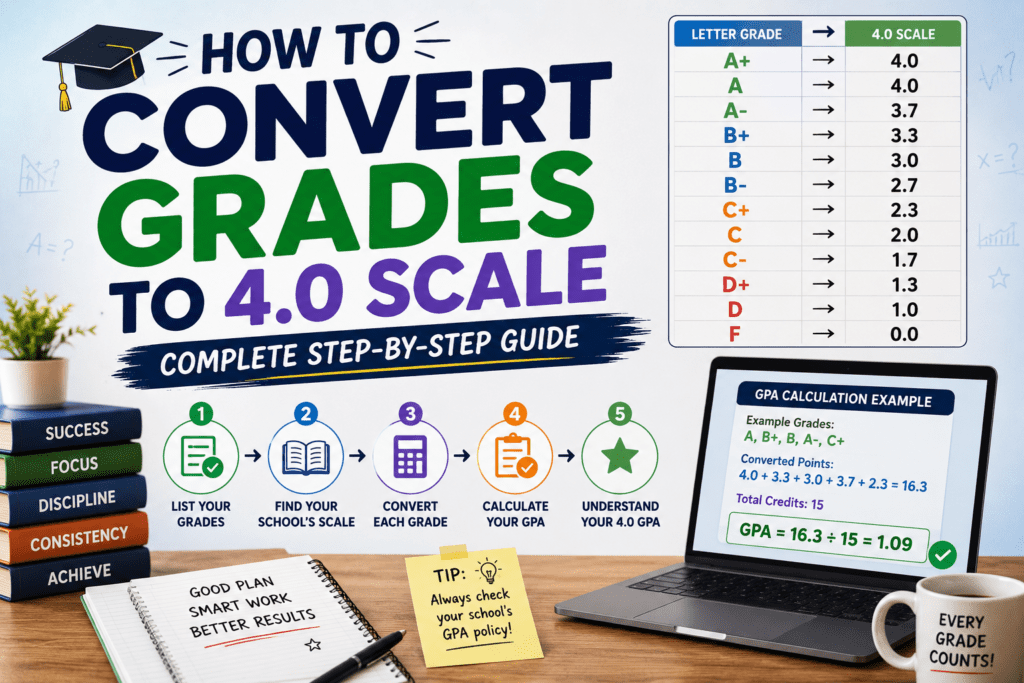
The Standard Letter Grade to 4.0 Scale Conversion Chart
The most common way students need to convert grades to the 4.0 scale is from letter grades. Here is the standard conversion table used by most high schools and colleges in the United States:
| Letter Grade | Percentage | 4.0 GPA Value |
|---|---|---|
| A+ | 97–100% | 4.0 |
| A | 93–96% | 4.0 |
| A- | 90–92% | 3.7 |
| B+ | 87–89% | 3.3 |
| B | 83–86% | 3.0 |
| B- | 80–82% | 2.7 |
| C+ | 77–79% | 2.3 |
| C | 73–76% | 2.0 |
| C- | 70–72% | 1.7 |
| D+ | 67–69% | 1.3 |
| D | 63–66% | 1.0 |
| D- | 60–62% | 0.7 |
| F | Below 60% | 0.0 |
Most schools use a straightforward conversion where a grade of 90–100% becomes an A at 4.0, 80–89% becomes a B at 3.0, 70–79% becomes a C at 2.0 — though real grading systems often add extra layers like plus/minus grades, different cutoffs, and course weights that change the final GPA value. The GPA Calculator
How to Convert Percentage Grades to the 4.0 Scale
If your school uses percentage grades instead of letter grades, you convert grades to the 4.0 scale by first mapping your percentage to the corresponding letter grade using the chart above, then assigning the 4.0 value.
Step-by-step percentage conversion:
- Find your percentage grade (e.g., 88%)
- Map it to a letter grade (88% = B+)
- Assign the 4.0 value (B+ = 3.3)
- Repeat for every course
- Add all GPA points together and divide by the total number of courses
Example: If you scored 92%, 85%, 78%, and 95% in four subjects:
- 92% = A- = 3.7
- 85% = B = 3.0
- 78% = C+ = 2.3
- 95% = A = 4.0
- Total: (3.7 + 3.0 + 2.3 + 4.0) ÷ 4 = 3.25 GPA
You can also use the direct formula: 4.0 GPA = (Your Grade ÷ Maximum Possible Grade) × 4
This formula works across different grading scales — if your school uses a grading system different from the standard 100-point scale, divide your GPA by the highest possible GPA on your scale and multiply by 4 to get your standardized 4.0 equivalent.
Unweighted vs. Weighted GPA — What Is the Difference?
This is where many students get confused during grade conversion. Your school may report either an unweighted or a weighted GPA, and these two numbers look very different on a transcript.
Unweighted GPA
An unweighted GPA treats every course equally, regardless of difficulty. An A in a regular English class carries the same 4.0 value as an A in Advanced Placement Chemistry. The maximum unweighted GPA is always 4.0.
Weighted GPA
Schools that use a weighted GPA scale assign more points to honors and AP classes — for example, a student who earns an A in AP Calculus receives a 5.0 on a weighted scale but only a 4.0 on an unweighted scale, with honors courses typically falling between 4.0 and 4.5 depending on the school’s policy.
An unweighted GPA uses the standard 4.0 scale, while a weighted GPA rewards tougher courses like Honors or AP by giving extra grade points — meaning an A in an AP class can count as 5.0 instead of 4.0, reflecting the additional academic challenge of the course.
Which one do colleges look at? Most colleges recalculate your GPA on their own unweighted 4.0 scale during admissions review, so both numbers matter. Always report both on applications when asked.
How to Convert a 5.0 Weighted GPA to the 4.0 Scale
If your school uses a 5.0 weighted scale, you convert it to the 4.0 scale using this formula:
4.0 Scale GPA = (Weighted GPA ÷ 5.0) × 4.0
Example: A 4.5 weighted GPA on a 5.0 scale converts as follows:
- (4.5 ÷ 5.0) × 4.0 = 3.6 on the 4.0 scale
This gives colleges a standardized number they can compare across applicants from different school systems.
How to Convert International Grades to the 4.0 Scale
Students studying outside the United States often use entirely different grading systems. Here is how common international systems convert to the 4.0 GPA scale:
Percentage-Based Systems (India, Pakistan, Middle East)
- 90–100% → 4.0
- 80–89% → 3.0–3.7
- 70–79% → 2.0–2.7
- 60–69% → 1.0–1.7
- Below 60% → 0.0
UK Grading System
- First Class (70%+) → 4.0
- Upper Second / 2:1 (60–69%) → 3.3–3.7
- Lower Second / 2:2 (50–59%) → 2.7–3.0
- Third Class (40–49%) → 2.0–2.3
10-Point Scale (Common in South Asia)
Use the formula: (Your Score ÷ 10) × 4 = 4.0 Scale GPA
- Example: 8.5 out of 10 → (8.5 ÷ 10) × 4 = 3.4 GPA
What Is Considered a Good GPA on the 4.0 Scale?
Once you convert your grades to the 4.0 scale, understanding what your number means in context is equally important.
The average GPA across all U.S. high schools is 3.0, while the average GPA across all U.S. colleges is 3.1 — though these numbers vary significantly between school districts and institutions, meaning context always matters when evaluating your GPA.
Here is a general benchmark guide:
| GPA Range | Academic Standing |
|---|---|
| 3.7 – 4.0 | Excellent — Dean’s List level |
| 3.3 – 3.6 | Very Good — competitive for most colleges |
| 3.0 – 3.2 | Good — meets most admission requirements |
| 2.7 – 2.9 | Above Average — some programs may require higher |
| 2.0 – 2.6 | Average — may limit selective college options |
| Below 2.0 | Below Average — academic probation risk |
How Credit Hours Affect Your 4.0 GPA Conversion
Most students overlook credit hours when converting grades to the 4.0 scale — but they have a significant impact on your final GPA calculation. A 4-credit course carries more weight than a 1-credit course, so your grade in a higher-credit class influences your overall GPA more.
Weighted GPA formula using credit hours:
- Multiply each course’s grade point value by its credit hours
- Add all the results together
- Divide by the total number of credit hours
Example:
- Biology (4 credits) — A = 4.0 → 4 × 4.0 = 16
- History (3 credits) — B+ = 3.3 → 3 × 3.3 = 9.9
- Math (3 credits) — A- = 3.7 → 3 × 3.7 = 11.1
- Total points: 37 ÷ Total credits: 10 = 3.7 GPA
It is also important to know how to convert between semester and quarter credit hours — to convert semester hours to quarter hours, multiply each semester credit hour by 1.5, and to convert quarter hours to semester hours, multiply each quarter hour by 0.67.
Use a Free Grade Calculator to Convert Instantly
Manually converting grades to the 4.0 scale takes time and leaves room for calculation errors. The fastest and most accurate method is to use a free online grade calculator that handles the conversion automatically.
easygradecalculator.co gives you an instant GPA conversion — simply enter your letter grades or percentage scores along with your credit hours, and the calculator converts everything to the 4.0 scale in real time. It supports weighted and unweighted GPA, multiple semesters, and cumulative GPA tracking — making it the perfect tool for students at every level.
Frequently Asked Questions
How do I convert my grades to a 4.0 scale manually?
Map each letter grade to its 4.0 value using the standard conversion chart (A = 4.0, B = 3.0, C = 2.0, D = 1.0, F = 0.0), add all grade points together, and divide by the total number of courses. For credit-weighted GPA, multiply each grade point by its credit hours before averaging.
Is a 3.5 GPA on a 4.0 scale good?
Yes. A 3.5 GPA on the 4.0 scale is considered very good and makes you competitive for admission at most colleges and universities in the United States. Many scholarship programs also use 3.5 as their minimum GPA requirement.
Do all colleges use the 4.0 GPA scale?
Most U.S. colleges and universities use the 4.0 scale as their standard. However, some institutions use a 5.0 weighted scale or their own internal grading system. Always check the specific requirements of each school you are applying to.
What if my school uses a 100-point grading scale?
Use the formula: (Your Score ÷ 100) × 4 = 4.0 GPA equivalent. Alternatively, map your percentage to the letter grade conversion chart and use the standard 4.0 values.
Does converting to the 4.0 scale change my actual GPA?
The conversion gives you a standardized equivalent of your GPA — it does not change the grades on your transcript. Colleges use this standardized number to compare applicants from different schools and grading systems fairly.
Conclusion
Converting grades to the 4.0 scale does not have to be complicated. By understanding the standard letter grade conversion chart, the difference between weighted and unweighted GPA, and how credit hours affect your final number, you gain full control over your academic standing.
Whether you are preparing for college applications, tracking your semester performance, or converting international grades for a U.S. program, mastering how to convert grades to the 4.0 scale is an essential academic skill every student needs.
Use the free grade conversion calculator at easygradecalculator.co to convert your grades to the 4.0 scale instantly — no formulas, no guesswork, just your accurate GPA in seconds.